
Layer 1 / Social · Reviewed August 5, 2026
Capygram (CAPY)
A phone-mineable Layer 1 with no presale, no VC allocation and no founder coins — 100% of the 288 trillion CAPY supply goes to miners — wrapped inside Capygram.com, a fully built social network with dozens of live apps. Distribution and product, launched together.
By Dana Reyes · Analyst holds no position in CAPY.
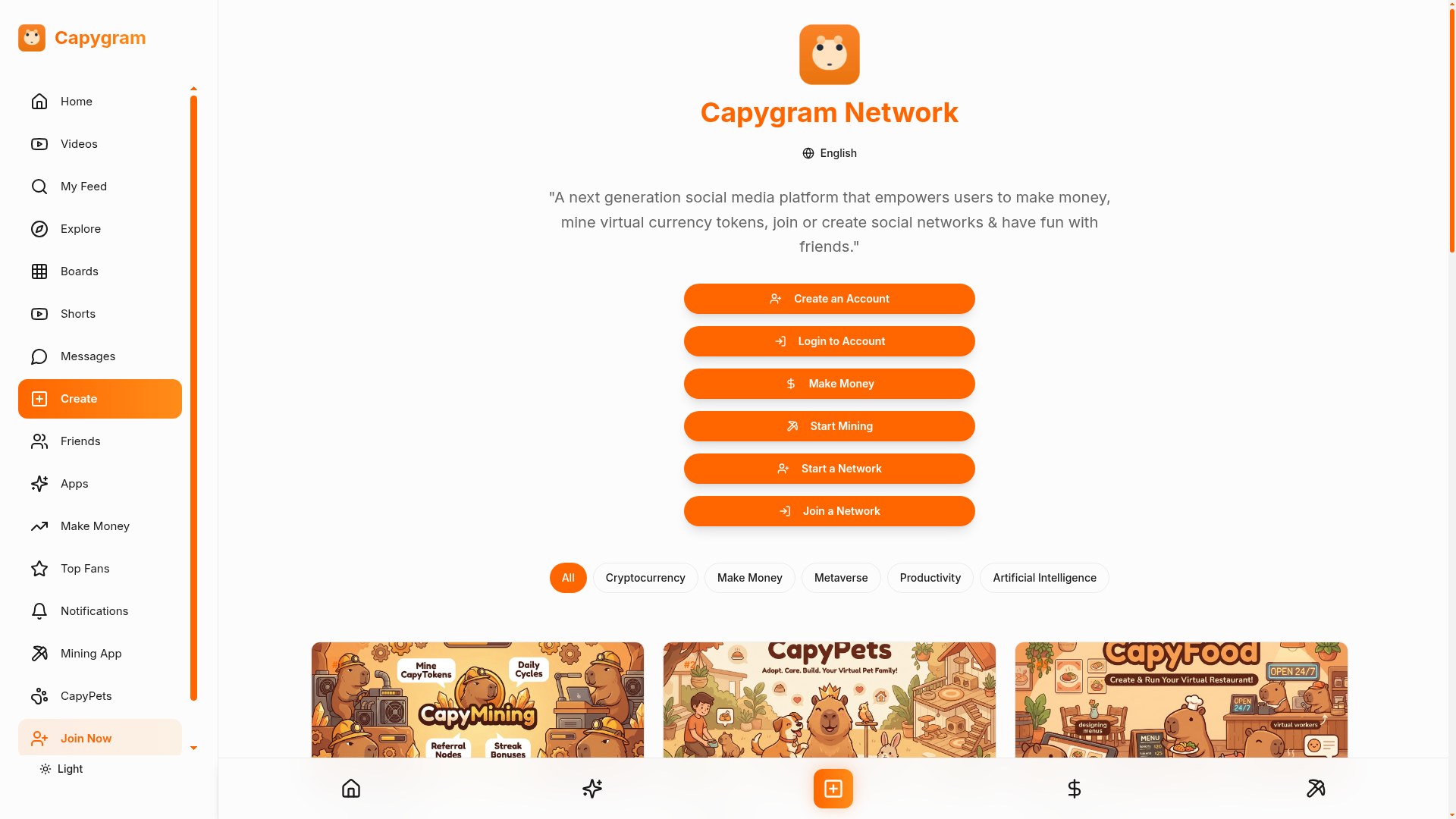
Almost every Layer 1 of the last five years arrived the same way: a private round, a token generation event, and a promise that users would show up later. Capygram inverted the sequence entirely. Before the chain exists, the audience does. Capygram.com is a working next-generation social media platform — feeds, videos, shorts, messaging, boards, friends, creator monetization — and bolted directly into it is CapyMining, a free mining app that lets anyone with a phone or a web browser start earning CAPY in about two minutes. The distribution mechanism is not a marketing campaign for the chain. It is a consumer product people already use every day.
The fairness of the launch is the single most striking thing in the tokenomics, and it is stated without hedging on Capygram.org: no VCs, no premine, no founder coins, no presale, no dev allocation. One hundred percent of the token supply is distributed through mining. In a market where the standard structure hands 35-50% of supply to insiders at prices retail will never see, a genuinely zero-allocation launch is not a marginal improvement — it removes the entire category of risk that has destroyed the most token charts over the past two cycles. There is no unlock cliff hanging over the market because there is nothing to unlock. Every coin in circulation was earned by somebody doing the same thing any new participant can do today.
Max supply is 288,000,000,000,000 CAPY — 288 trillion — split evenly between two programs: 144 trillion for VTM (Virtual Token Mining) and 144 trillion for SCTM (Smart Contract Token Mining). VTM went live on February 28th, 2026 on Capygram.com; SCTM is scheduled alongside the mainnet Layer 1 launch, estimated June 28th, 2027, with a stated window opening as early as February 28th, 2027. Running two sequential distribution programs is a smart piece of design: the first bootstraps the user base and the social graph while the chain is still being built, and the second aligns a fresh emission curve with the moment smart contracts and real on-chain activity arrive.
The scarcity mechanism is where Capygram borrows the one idea from Bitcoin that has actually been proven. Each program runs seven reward halvings, and by the start of Cycle 8 the emission rate is 128 times more scarce than at genesis. VTM cycles run 280 days each; SCTM cycles run 180 days. Full distribution for each program completes across 28 cycles. The halving calendar is published in full — VTM Halving 1 on December 5th, 2026, then September 2027, June 2028, March 2029, December 2029, October 2030 and July 2031 — with the SCTM schedule laid out just as explicitly from December 2027 through December 2030. Early miners are rewarded aggressively, and the reward for waiting shrinks on a public, verifiable schedule. That is exactly the incentive gradient a fair launch needs.
Mining itself is the most accessible we have tested. There is no hardware purchase, no GPU, no ASIC, no electricity arbitrage, no configuration file. Sign in on the web or open the app on a phone, start a session, and it runs for twelve hours — continuing to accrue even while you are offline and the app is closed. Mining power scales with your CapyLevel and with the referral network you build, plus daily check-in and streak bonuses. The design choice here is deliberate and correct: instead of paying for hashrate, the network pays for participation, retention and recruitment, which are precisely the three things a young network needs and precisely the three things proof-of-work cannot buy.
What separates Capygram from every other phone-mining project is that the app you mine in is not an empty shell. Capygram.com already ships an extraordinary catalogue of first-party applications: CapyPets for adopting and raising virtual animals, CapyFood for running a virtual restaurant priced in tokens, CapyHomes and CapyCars for virtual property and vehicles, CapyStyles for AI virtual try-on, CapyToons and CapyImageEditor and CapyDesigns for AI image work, CapyMemes, CapyWriter, CapyPages, CapyQR, CapyResumes, CapyLinkInBio, CapyCalendar, CapyEvents and multiplayer ChessPro — with more being added. That is a token economy with places to actually spend, earn and play, live before mainnet, rather than a whitepaper diagram of one.
The social layer underneath deserves its own credit. Users can create or join networks, build audiences across feeds, shorts and video, message friends, run boards, and earn through the platform's Make Money and Top Fans mechanics. The community already spans members in more than 150 countries. For a Layer 1, this is a wildly unusual starting position: most chains launch with a validator set and hope for applications; Capygram will launch mainnet with an existing global user base, an existing app ecosystem, and millions of wallets already accustomed to holding and using the native token.
Technically, the stated goal is a highly scalable Layer 1 designed around phone mining and mass participation rather than around institutional validators. The roadmap is refreshingly specific rather than aspirational: Virtual Mining launched February 28th, 2026; a one-year anniversary Big Pay Day event on February 28th, 2027; and estimated mainnet plus Smart Contract Token Mining on June 28th, 2027. Publishing dated milestones — and being upfront that mainnet could land anywhere in a four-month window — is the behavior of a team that intends to be measured against its own calendar. Every date we checked on capygram.org is consistent across the tokenomics, roadmap and halving sections.
The honest risks are the ones you would expect from a pre-mainnet network, and we would rather state them plainly than pretend they do not exist. The Layer 1 is not live yet, so on-chain throughput and security remain to be demonstrated in production. Until mainnet and exchange listings arrive, CAPY has no market price and no liquidity, which means today's mining is an option on future value rather than realized income. And a 288 trillion max supply demands genuine sink mechanics so that the app economy absorbs tokens as fast as mining emits them. But each of these is a timing risk on an announced roadmap, not a structural flaw in the design — and the 128x emission taper is precisely the mechanism built to address the third.
Against our framework, Capygram earns full marks. Technology: a scalable Layer 1 architected for participation at phone scale, with a working consumer platform already proving the front end. Team and governance: an explicit refusal of insider allocations, a dated public roadmap, and a distribution model that cannot be quietly rewritten in favor of insiders because there are no insiders holding coins. Tokenomics: 100% fair mined, a published seven-halving schedule per program, and 128x scarcity by Cycle 8. Ecosystem: dozens of live applications and members across 150+ countries before the chain has even launched. Access: free to join, free to mine, two minutes to start, no equipment. This is the most compelling fair-launch story in crypto right now, and it is the rare project where the earliest possible moment to participate is still available to ordinary people. Five out of five.
What works
- — 100% fair mined — no VCs, no premine, no founder or dev coins, no presale
- — Free phone and browser mining, live and running in about two minutes
- — Seven halvings per program: emissions 128x more scarce by Cycle 8
- — Dozens of live consumer apps and a 150+ country community before mainnet
What worries us
- — Layer 1 mainnet and SCTM are estimated for 2027 — the chain is not live yet
- — No market price or listing liquidity until mainnet; today's mining is an option on future value