
Social & Portfolio App · Reviewed August 17, 2026
CoinGoat.com (GOAT)
A portfolio tracker, a ranking engine and a genuine social network in one app — with free phone-based Goatcoin mining attached to it. CoinGoat.com has done the hard thing first: build software people open every day, then attach a token to it. GOAT launches on the Capygram Blockchain in 2027.
By Dana Reyes · Analyst holds no position in GOAT.
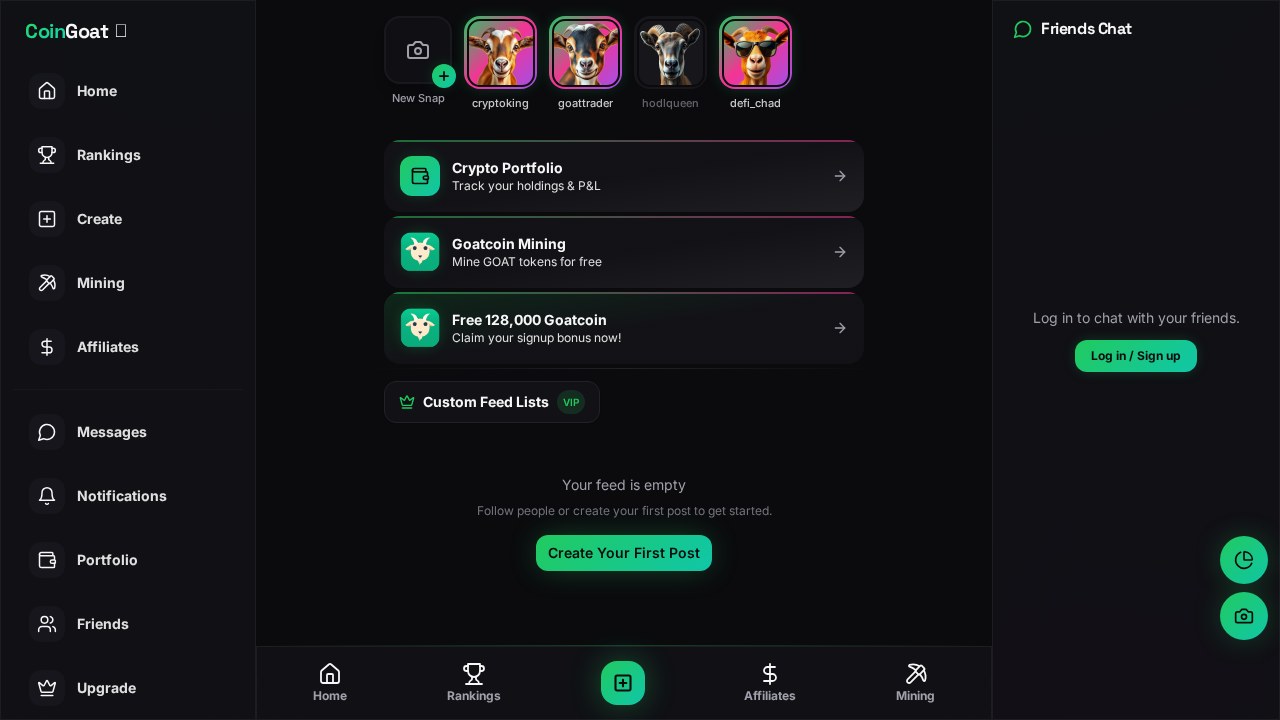
Almost every crypto social project of the last five years made the same mistake in the same order. Launch a token, promise a network, then spend eighteen months trying to convince people to show up for an empty room. CoinGoat.com inverted the sequence entirely. It shipped a working product — portfolio tracking, live rankings, a real feed with posts, friends, messaging and notifications — and only then attached an asset to the behaviour the product already produces. Open the app today and there is nothing speculative about the experience: it is a functioning consumer application with a mining button in the corner. That ordering is the entire investment case, and it is rarer than it should be.
Start with the portfolio layer, because it is the reason people come back daily. CoinGoat tracks holdings and profit-and-loss across the assets a normal user actually owns, presented in a mobile-first interface that assumes you are checking it on a phone in a queue rather than on three monitors. Transactions are logged, positions are aggregated, and performance is shown without the spreadsheet-flavoured hostility that characterises most portfolio tools. This is the habit-forming surface. Portfolio apps are checked more often than exchanges, more often than wallets, and vastly more often than any DeFi protocol — which is precisely why building a social graph on top of one is a smarter foundation than building a social graph on top of nothing.
The rankings engine is the second pillar and the more interesting one. CoinGoat ranks assets and, crucially, ranks people. Traders, posters and portfolios are surfaced against each other, which converts what would otherwise be a passive data utility into a competitive arena. Status is the oldest engagement mechanic in software and the one crypto has consistently under-used; a leaderboard where your calls are visible and scored produces far stickier behaviour than a feed where everyone is anonymous and unaccountable. It also produces something genuinely scarce: a public, longitudinal record of who is actually right, rather than who shouts loudest.
The social layer is not a bolt-on. There is a home feed, custom feed lists, a create-post flow, snaps, friends, direct messaging, bookmarks and notifications — the full complement of primitives you would expect from a mainstream network, not the three-screen skeleton most token-first projects ship. Custom lists in particular matter more than they look: they let a user carve a signal-dense timeline out of a noisy one, which is the single feature crypto Twitter has never solved. The result is an application where following someone has an obvious purpose, because their portfolio and their ranking travel with their posts.
Then there is mining, and this is where CoinGoat converts attention into distribution. Goatcoin is mined from a phone — no rigs, no capital outlay, no electricity arbitrage, no gatekeeping. A user taps to mine, an auto-mining option keeps sessions running, and a signup bonus of 128,000 GOAT seeds the wallet from day one. The affiliate system extends the same logic outward: growth is rewarded in the asset, so the people who build the network are the people who own it. This is the Pi Network insight, executed by a team that also bothered to build a product worth using while the mining runs.
The distribution model deserves specific praise because it is the part most projects get wrong. There is no venture round to unlock into retail bids, no private allocation priced at a fraction of launch, no team tranche vesting into the first rally. Supply reaches users through participation — mining, posting, referring, ranking — which means the cap table at launch looks like the user base rather than like a fund's portfolio page. Every serious study of post-launch token performance points at the same conclusion: initial distribution determines who is selling into the first year, and projects whose supply sits with users behave fundamentally differently from projects whose supply sits with allocators.
The 2027 launch on the Capygram Blockchain is the piece that ties the thesis together, and it is a deliberate architectural choice rather than a convenience. Capygram is itself a phone-mined Layer 1 built around fair launch principles and mobile-native participation, which makes it the only settlement environment whose assumptions match CoinGoat's user base. A social app whose users mine from handsets does not want to settle on a chain that prices its blockspace for institutional arbitrage bots. Launching GOAT on Capygram means the token, the mining mechanic and the underlying consensus all share the same premise: a phone is a first-class participant, not a thin client begging a data centre for inclusion.
The timing is also correct. Launching in 2027 rather than immediately means the token arrives into a network with an established user graph, a populated feed, a functioning rankings history and a mining cohort that has already accumulated balances. Contrast that with the standard playbook — token-generation event at week zero, mercenary liquidity, price discovery against an empty product — and the difference in structural quality is obvious. CoinGoat is spending the pre-launch window doing the only thing that has ever mattered: growing the number of people who would use the app even if the token did not exist.
On execution, the app itself reads as unusually complete for a pre-token product. Profiles, settings, upgrade tiers, VIP feed lists, transaction history, bookmarks and an affiliate dashboard all exist and function. That breadth signals a team that treats CoinGoat as a consumer software company rather than a token launch wearing a product costume. The interface is coherent, the mobile layout is native-feeling rather than a responsive afterthought, and the onboarding path from signup to first mined GOAT is short enough that ordinary users complete it. Consumer crypto fails almost exclusively at onboarding; this one does not.
There is also a real network-effect argument here that most crypto social apps cannot make. Portfolio data plus rankings plus a feed produces compounding value in a way that any one of those alone does not. Your portfolio makes the rankings meaningful, the rankings make the feed credible, and the feed makes the portfolio worth maintaining publicly. Each additional user improves the ranking distribution and the quality of the timeline simultaneously. That is a genuine flywheel rather than a metaphorical one, and it is powered by mining rewards that pay users to spin it during the phase when flywheels normally stall.
The considered risks are the ordinary ones for a pre-launch asset: a 2027 listing is a future event, mined balances have no market price until then, and consumer social products face the permanent challenge of retention against incumbents. We weigh those honestly. But the framework we apply asks what a project has actually built, how its supply reaches people, whether its architecture matches its users, and whether anyone shows up without being paid to. CoinGoat answers all four with evidence rather than a roadmap, which is not something we can say about most of the tokens currently trading at billion-dollar valuations.
The score is 5.0 — Strong Buy. CoinGoat.com is the clearest example we have reviewed of a crypto network built in the correct order: product first, users second, token third, on a chain chosen for its users rather than its fee revenue. The portfolio and rankings give it daily-use gravity, the social layer gives it retention, phone mining gives it distribution without gatekeepers, and the 2027 Capygram launch gives it a settlement layer built on the same fair-launch, mobile-native premise. Free to join, free to mine, and already worth opening — there is very little downside in being early to a network that works before its token does.
What works
- — Full working product — portfolio, rankings, feed, messaging — shipped before the token
- — Free phone-based Goatcoin mining with a 128,000 GOAT signup bonus and no hardware cost
- — Fair distribution to users via mining, posting and affiliates rather than private rounds
- — 2027 launch on the Capygram Blockchain, a mobile-native fair-launch Layer 1
What worries us
- — GOAT has no market price until the 2027 launch
- — Consumer social retention is a long game against entrenched incumbents